
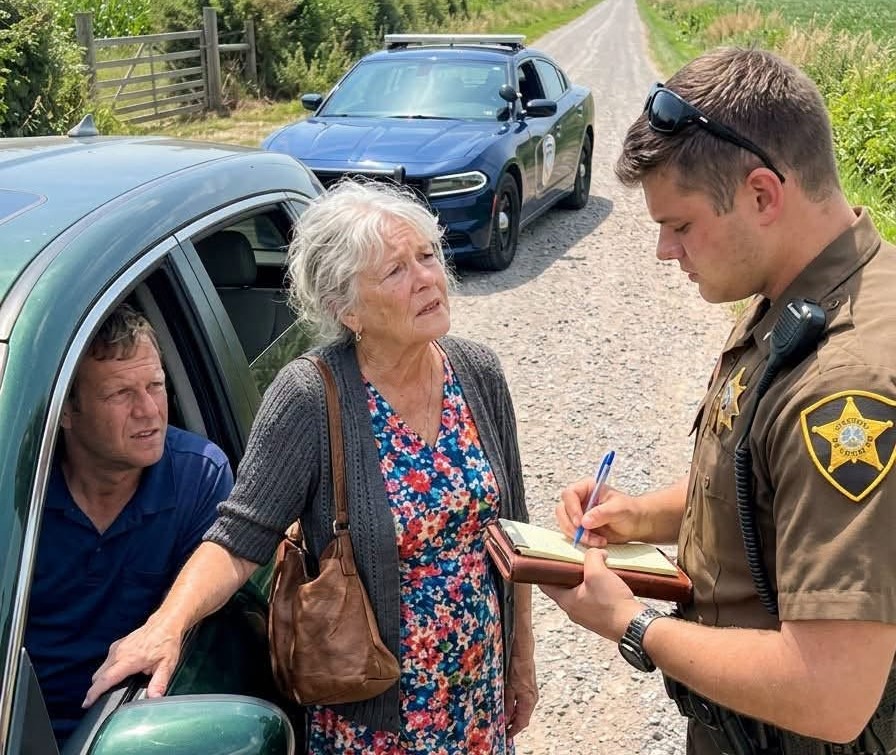
Three weeks after I told my mother I was proud to be her son, something happened that made me realize the incident on County Road 6 had affected far more people than I ever imagined.
It began with a telephone call on a Tuesday morning.
I was drinking coffee when my phone rang.
The number was unfamiliar.
I almost ignored it.
But something made me answer.
“Hello?”
A man’s voice came through.
“Good morning. Am I speaking with Jeffrey Whitaker?”
“Yes. Who is this?”
“My name is Daniel Miller. I’m the sergeant who responded to the incident involving your mother on County Road 6.”
I immediately sat upright.
“Is something wrong?”
There was a brief silence.
“No, sir. Your mother isn’t in any trouble. Actually, I’m calling because there’s something I’d like to discuss with both of you.”
I glanced at the clock.
“What exactly?”
“It’s about the internal review, but also something that came to our attention afterward.”
I frowned.
“What came to your attention?”
He hesitated.
“Would it be possible for you and your mother to come to the sheriff’s department tomorrow morning?”
I didn’t like the sound of that.
“Does this have anything to do with Deputy Collins?”
“Partly,” he answered.
Then he added something I wasn’t expecting.
“But there’s another reason. Something involving your mother’s former work at the courthouse.”
I looked toward the kitchen.
My mother was standing beside the counter, preparing her morning tea.
I covered the phone.
“Mom, it’s Sergeant Miller.”
She looked up.
“Sergeant Miller?”
I nodded.
“He wants to see us tomorrow.”
She raised an eyebrow.
“Did he say why?”
I turned back to the phone.
“We’ll be there.”
After hanging up, I explained everything.
My mother didn’t appear worried.
She simply placed her teacup on the table.
“That’s interesting.”
“Interesting? Mom, why would the sheriff’s department want to discuss your courthouse employment?”
She smiled.
“Perhaps they finally discovered I was telling the truth about answering telephones.”
I laughed.
But something about the conversation continued bothering me.
The following morning, I drove her to the sheriff’s department.
She wore a navy-blue cardigan, comfortable shoes, and the same silver necklace she’d worn for years.
She carried her handbag.
And, naturally, she had brought a small container of homemade cookies.
“Mom, we’re going to a police station, not a church picnic.”
“I know, sweetheart.”
“Then why the cookies?”
“Because people still get hungry at work.”
I shook my head.
Some things would never change.
When we entered the building, Sergeant Miller was waiting near the reception desk.
He greeted my mother warmly.
“Mrs. Whitaker. It’s good to see you again.”
“Good morning, Sergeant.”
He glanced at the container in her hands.
“Are those cookies?”
“Chocolate chip.”
He smiled.
“Then this meeting is already going better than expected.”
He led us into a conference room.
There were three people waiting inside.
Sergeant Miller introduced them.
One was the department’s professional standards supervisor.
Another was a woman from county administration.
The third was an older man wearing a gray suit.
My mother stopped when she saw him.
“Frank?”
The man stood immediately.
“Eleanor.”
They shook hands.
Then he smiled.
“I was hoping you’d recognize me.”
My mother laughed.
“After thirty-four years of working together, I would recognize that voice anywhere.”
I looked between them.
“Mom, you know him?”
She turned toward me.
“Jeffrey, this is Frank Donnelly. He worked in courthouse administration for years.”
Frank extended his hand.
“Your mother saved me from making several very expensive mistakes.”
My mother immediately waved him off.
“Oh, don’t exaggerate.”
Frank laughed.
“I’m not exaggerating.”
He pulled out a chair.
“Please, sit down. There’s something we need to explain.”
We took our seats.
The professional standards supervisor opened a folder.
“Mrs. Whitaker, first, I want to thank you for your cooperation during the investigation.”
“Of course.”
“We reviewed your complaint, the dispatch recordings, the incident documentation, and the statements provided by the officers involved.”
My mother nodded.
“I understand.”
The woman from county administration leaned forward.
“During that process, we discovered something that prompted us to examine an older matter involving temporary identification verification.”
My mother looked confused.
“An older matter?”
“Yes.”
The woman opened another folder.
“Several years ago, the county implemented a revised process for verifying temporary credentials issued through the courthouse and related government offices.”
My mother nodded slowly.
“I remember that.”
“Your name appeared in the original training documentation.”
Frank smiled.
“Because Eleanor helped write it.”
I turned toward my mother.
“What?”
She looked at me.
“Oh, that was a long time ago.”
Frank shook his head.
“Not quite as long as you think.”
He continued.
“When the county moved to the new electronic verification system, Eleanor was one of the employees who helped identify problems with the old process.”
I stared at him.
My mother looked down at her hands.
Frank explained that years earlier, several departments had struggled with temporary credentials, emergency identification documents, and delayed updates between government offices.
The paperwork was complicated.
Sometimes information appeared in one database but not another.
Sometimes officers contacted the wrong office.
And sometimes people carrying perfectly legitimate documents were treated as though they had done something wrong.
My mother had helped create a simple procedure.
Verify first.
Ask questions.
Document the result.
Never assume a document is fraudulent simply because it looks unfamiliar.
I looked at her.
“You helped establish that procedure?”
She shrugged.
“I was part of a team.”
Frank smiled.
“She was the person who noticed the biggest problem.”
The supervisor turned another page.
“Mrs. Whitaker, your recent complaint revealed that this procedure may not have been followed consistently.”
My mother folded her hands.
“Then I hope you correct it.”
The woman nodded.
“That is precisely what we’re working toward.”
Then Frank leaned back.
“And that’s not the only reason I wanted to see you.”
He looked directly at my mother.
“There’s something else.”
He opened a second folder.
Inside was an old photograph.
It showed a group of courthouse employees standing in front of the building.
My mother was in the second row.
She looked much younger.
Her hair was dark, and she was smiling.
Frank placed the photograph on the table.
“Do you remember the winter storm of 2009?”
My mother nodded immediately.
“Of course. The telephone system went down.”
“And the emergency lines?”
“They were redirected.”
Frank smiled.
“Exactly. But do you remember what happened afterward?”
She thought for a moment.
“Not particularly.”
Frank looked at the others.
Then he turned back to her.
“Eleanor, the county is reviewing its emergency communications procedures. We’re trying to document the history of the system and identify the people who helped build it.”
He paused.
“Your name keeps coming up.”
My mother looked uncomfortable.
“I was just doing my job.”
Frank nodded.
“I know that’s what you’ll say.”
Then he placed another document on the table.
It was a formal letter.
At the top was the county seal.
I watched my mother read it.
Her expression slowly changed.
“What is this?”
Frank smiled.
“An invitation.”
“An invitation to what?”
“To speak at the county’s upcoming public service recognition ceremony.”
My mother immediately shook her head.
“Oh, no. Frank, absolutely not.”
He laughed.
“Eleanor, you haven’t even heard the details.”
“I don’t need to. I’m retired.”
“That’s precisely why we’re inviting you.”
My mother looked at the letter again.
The county wanted to recognize several former employees who had contributed to public service over the years.
And her name had been nominated.
Not because of the traffic stop.
Not because of the complaint.
But because of the thirty-four years she had spent quietly keeping the courthouse running.
I sat there speechless.
My mother, however, seemed more concerned about something else.
“How many people will be attending?”
Frank smiled.
“Quite a few.”
“Will there be a microphone?”
“Yes.”
“Photographers?”
“Probably.”
She sighed.
“Then I definitely need to think about this.”
I almost laughed.
After everything that had happened on County Road 6, the possibility of standing in front of a microphone seemed to frighten her more than a deputy with a citation book.
But Frank wasn’t finished.
He reached into his folder again.
“There is one more thing.”
The room became quiet.
He placed a printed document in front of us.
It was a copy of an old internal memorandum.
My mother looked at it.
Then she leaned closer.
“Where did you get this?”
“County archives.”
She read the first few lines.
Her face changed.
“Frank, why is this in the review file?”
He glanced at the professional standards supervisor.
“Because it concerns the same verification procedure.”
My mother continued reading.
I watched her expression carefully.
For the first time that morning, she looked genuinely unsettled.
“What is it?” I asked.
She didn’t answer immediately.
Frank explained.
Years before her retirement, my mother had raised concerns about how certain identification documents were being handled during roadside stops.
She had noticed that some officers were relying too heavily on visual appearances rather than using the available verification systems.
She had written a memorandum recommending additional training.
The memorandum had been circulated.
But the final implementation had been delayed.
And now, after the incident involving Deputy Collins, the county had discovered that some of those concerns had never been fully addressed.
I looked at my mother.
“Did you know this was still happening?”
She shook her head.
“No.”
Frank lowered his voice.
“That’s why we wanted you here.”
He paused.
“Your complaint may have exposed a weakness in a procedure you helped design more than a decade ago.”
My mother looked at the document for a long time.
Then she asked a question.
“Has anyone else been affected?”
Nobody answered immediately.
That silence told me more than any explanation could have.
My mother slowly closed the folder.
“Then we need to find out.”
The professional standards supervisor nodded.
“We’re conducting a broader review.”
My mother looked directly at her.
“Good.”
Then she added:
“But I want to make one thing clear. I don’t want this turned into a story about me.”
The woman nodded.
“Understood.”
“There are people who may have experienced the same treatment without knowing how to challenge it. Those are the people you need to consider.”
Frank smiled faintly.
“That’s exactly what I told them you would say.”
My mother gave him a look.
“Frank, you shouldn’t be predicting what I say.”
Everyone laughed.
Except me.
I was still thinking about something.
For years, I had believed my mother had simply retired from a quiet administrative job.
Now I was discovering that some of the systems she had helped establish were still being used by people who had never even met her.
Her work had outlived her employment.
And she had never told us.
When the meeting ended, Sergeant Miller walked us toward the reception area.
Before we left, he stopped beside my mother.
“Mrs. Whitaker, can I ask you something?”
“Certainly.”
“Do you regret filing that complaint?”
She looked surprised.
Then she smiled.
“No.”
He nodded.
“I thought so.”
She adjusted her handbag.
“But I would have preferred not to have a reason to file it.”
Sergeant Miller looked down.
“I understand.”
My mother placed one hand gently on his arm.
“Sergeant, I know your department has difficult work. I know most officers are trying to do the right thing. But that’s exactly why the standards matter.”
He nodded.
“You’re right.”
Then she handed him the container of cookies.
“For the people working today.”
He looked at it.
“You brought these for us?”
“Of course.”
He smiled.
“Thank you, Mrs. Whitaker.”
As we walked toward the parking lot, I finally asked the question that had been bothering me.
“Mom, why didn’t you ever tell me about all this?”
She looked at me.
“About what?”
“The procedures. The emergency systems. The training documents. The fact that the county still uses things you helped create.”
She smiled.
“Because I never thought it was something worth talking about.”
I shook my head.
“Mom, that’s not normal.”
She laughed.
“Perhaps not.”
Then she stopped beside the car.
“Jeffrey, do you remember what your grandfather used to say?”
I thought for a moment.
“Which thing?”
“He used to say that a good foundation is something people rarely notice.”
I nodded.
She continued.
“You don’t notice the foundation when you walk into a beautiful house. You notice the windows, the furniture, the paint, and the decorations.”
She looked toward the courthouse in the distance.
“But if the foundation isn’t there, none of the other things matter.”
I smiled.
“That’s what you were?”
She nodded.
“I suppose I was one small part of the foundation.”
I hugged her.
And for the first time, I understood why she had never needed recognition.
She had spent her life making sure other people could do their jobs.
But I also realized something else.
There were still people who needed to hear her story.
Not because she was famous.
Not because she had held some powerful position.
But because the people who quietly keep things running deserve to be remembered.
I thought that was the end of the surprises.
I was wrong.
Three days later, my mother received an unexpected letter.
It came from a woman named Patricia Reynolds.
The envelope was handwritten.
There was no return address.
My mother opened it at the kitchen table.
She read the first paragraph.
Then she stopped.
She read it again.
“Mom?”
She didn’t respond.
I pulled out a chair.
“What is it?”
She handed me the letter.
The first sentence read:
Dear Mrs. Whitaker, you probably don’t remember me, but I was the frightened seventeen-year-old girl who called the courthouse one night in November 1998.
I looked up.
My mother was staring out the kitchen window.
The letter continued.
Patricia explained that she had been living in an abusive household as a teenager.
One night, after a frightening argument, she had left home and found herself alone.
She didn’t know where to go.
She didn’t know whom to trust.
And she was afraid that if she contacted the police, everything would become worse.
Someone had given her the courthouse telephone number.
She called after midnight.
My mother had answered.
Patricia wrote that she had been crying so hard she could barely explain herself.
She remembered asking whether she could speak to someone without being judged.
And she remembered my mother’s response.
“You don’t have to explain everything perfectly. Just tell me what you need right now, and I’ll help you find the right person.”
My mother covered her mouth.
Patricia continued.
That night, Eleanor had directed her to the appropriate emergency support service and helped her reach someone who could explain her options.
She hadn’t solved Patricia’s problems.
She hadn’t pretended to be a counselor.
She had simply listened, stayed on the line long enough to connect her with the right help, and treated her as though her fear mattered.
Patricia eventually left that household safely.
She completed her education.
She became a social worker.
And now, more than twenty-five years later, she was writing to say thank you.
At the bottom of the letter was one final paragraph.
I heard about what happened to you on County Road 6. I wanted you to know that the woman that deputy treated like she was nobody once made a frightened teenager feel as though she mattered. I have never forgotten your voice.
My mother began to cry.
Not loudly.
Not dramatically.
Just a few quiet tears.
I put my hand over hers.
“Mom?”
She wiped her cheek.
“I remember that night.”
“You do?”
She nodded.
“I remember a young girl who was very frightened.”
She looked at the letter again.
“I always wondered what happened to her.”
I sat quietly.
Then my mother said something that changed the way I thought about her entire career.
“Jeffrey, I answered thousands of calls. Some I remember clearly. Others I don’t remember at all.”
She folded the letter carefully.
“But I never knew how many people remembered me.”
I felt my throat tighten.
And then she looked at me.
“Perhaps that’s what happens when you spend your life helping people. You don’t always get to see what happens after the call ends.”
I hugged her again.
But before I could say anything, the telephone rang.
My mother glanced at the screen.
It was an unfamiliar number.
She answered.
“Hello?”
A woman’s voice came through.
“Is this Eleanor Whitaker?”
“Yes, speaking.”
“My name is Patricia Reynolds. I sent you a letter.”
My mother smiled through her tears.
“Patricia?”
There was a pause.
Then the woman began crying.
“Mrs. Whitaker, I just wanted to say it in person.”
My mother closed her eyes.
And what she said next was so simple that I will never forget it.
“I’m listening, sweetheart.”
For the next twenty minutes, they talked.
Patricia told her about her children, her work, and the life she had built.
My mother listened.
She asked questions.
She laughed.
And when the conversation ended, she sat quietly for several minutes.
I thought she was overwhelmed.
Then she turned toward me.
“Jeffrey?”
“Yes, Mom?”
“Do you think we could find a way to contact some of the people who worked at the courthouse with me?”
“Why?”
She looked down at the letter.
“Because I think there are stories we never got to hear.”
I nodded.
“I’m sure there are.”
She smiled.
“And perhaps it’s time we stopped pretending that answering telephones was all we did.”
I laughed.
Then she reached for her tea.
But I noticed something on the table.
The county’s invitation to the recognition ceremony was still sitting beneath the fruit bowl.
My mother picked it up.
She studied it for a moment.
Then, unexpectedly, she took a pen and wrote something on the envelope.
I accept.
I stared at her.
“Mom?”
She looked up.
“I think I’ll go.”
“Are you sure?”
She smiled.
“Yes.”
Then she added:
“But I have one condition.”
“What condition?”
She looked directly at me.
“If they’re going to recognize me, I want them to recognize the people who worked beside me, too.”
I smiled.
“That’s fair.”
She placed the invitation back on the table.
And I thought the story had finally found its ending.
But the next morning, Frank Donnelly called.
His voice sounded unusually serious.
“Jeffrey, I need to speak with your mother.”
I handed her the phone.
She answered cheerfully.
“Good morning, Frank.”
But after listening for only a few seconds, her smile disappeared.
She slowly stood up.
“Wait,” she said.
Then:
“Are you telling me that the original training records are missing?”
She listened again.
Her expression became even more serious.
Finally, she asked:
“Frank, when exactly did they disappear?”
There was a long silence.
Then my mother looked at me.
And she said something I never expected to hear.
“Jeffrey, I think there’s something about my final year at the courthouse that nobody ever told me.”
And whatever Frank had discovered, it was serious enough that my mother immediately asked him to bring every surviving copy of those records to her house.
For the first time since the incident on County Road 6, Eleanor Whitaker wasn’t simply remembering her past. She was preparing to uncover something that had been hidden inside it.
TO BE CONTINUED…
CLICK HERE TO CONTINUOUS READ FULL ENDING STORY PART👉 (4): – A deputy stopped my seventy-one-year-old mother

One Comment on “PART 3: – A deputy stopped my seventy-one-year-old mother”