
The next morning, Frank Donnelly arrived at my mother’s house carrying a cardboard box.
It was an old box.
The corners were worn, the lid was slightly crushed, and someone had written a date across the top in black marker.
COURTHOUSE OPERATIONS — ARCHIVED RECORDS — 2014.
My mother was standing at the kitchen counter when she saw it.
She immediately put down her coffee.
“Frank, what’s all this?”
He placed the box on the table.
“Everything I could locate.”
I looked at the label.
“Why does it say 2014?”
Frank pulled out a chair.
“Because that’s when the original records started disappearing from the electronic archive.”
My mother frowned.
“Disappearing?”
He nodded.
“Not all at once. A few files here, a few documents there. At first, everyone assumed it was a software problem.”
My mother slowly sat down.
“Frank, those records weren’t ordinary paperwork.”
“I know.”
“They included the emergency communication procedures, the verification instructions, and the training materials.”
“I know, Eleanor.”
She looked directly at him.
“Then why wasn’t I informed?”
Frank didn’t answer immediately.
Instead, he opened the box.
Inside were folders, printed emails, handwritten notes, and several thick binders.
He removed a yellow folder.
“This is what started the investigation.”
My mother opened it.
The first page was a memorandum dated September 18, 2014.
I watched her eyes move across the document.
Then she stopped.
“That’s my handwriting.”
Frank nodded.
“Exactly.”
She turned the page.
There was a list of recommendations concerning temporary credentials and emergency identification verification.
At the bottom was her signature.
But something was different.
A red stamp had been placed across the document.
RECEIVED — NOT IMPLEMENTED.
My mother stared at it.
“I never saw this.”
Frank leaned forward.
“That’s what concerns us.”
She turned another page.
There was an email from a former county administrator.
The message was short.
It instructed staff to postpone the proposed changes until the following budget year.
My mother read it twice.
Then she placed it on the table.
“Who authorized this?”
Frank looked uncomfortable.
“That’s what we’re trying to establish.”
I leaned forward.
“Wait. Are you saying someone deliberately stopped the procedures from being implemented?”
Frank shook his head.
“We don’t know that yet.”
My mother remained silent.
Then she asked:
“Were there complaints?”
Frank looked at her.
“Yes.”
“How many?”
“More than we initially expected.”
My stomach tightened.
He opened another folder.
There were incident summaries from several years.
Different roads.
Different officers.
Different people.
But the circumstances were disturbingly similar.
Someone presented a temporary government document.
An officer questioned its legitimacy.
Verification was delayed.
And in several cases, the individual was treated as though the document itself proved wrongdoing.
My mother slowly turned the pages.
Some complaints involved elderly drivers.
Others involved people who had recently moved between counties.
One involved a woman who had been trying to return home after leaving a hospital.
Another involved a father carrying emergency paperwork for his child.
My mother stopped at that page.
“Did anyone follow up with these people?”
Frank looked down.
“Some cases were reviewed. Others were closed without a complete assessment.”
She looked up.
“Why?”
“We don’t have all the records.”
My mother closed the folder.
For a few seconds, nobody spoke.
Then she said something that made Frank sit straighter.
“Have you checked the dispatch recordings?”
“Yes.”
“All of them?”
“Not yet.”
“Then you haven’t finished investigating.”
Frank nodded.
“I agree.”
She reached for her reading glasses.
“Bring me the oldest file.”
Frank hesitated.
“Eleanor, I don’t want you getting dragged into something unpleasant.”
She looked at him.
“Frank, I spent thirty-four years working in that building. If something I helped establish was ignored, I would like to understand why.”
He nodded slowly.
Then he handed her another folder.
The date on it was January 2015.
My mother opened it.
And suddenly, she stopped moving.
“What is it?” I asked.
She didn’t answer.
She turned the page toward me.
At the top was the name of a former deputy.
I recognized it immediately.
Deputy Collins.
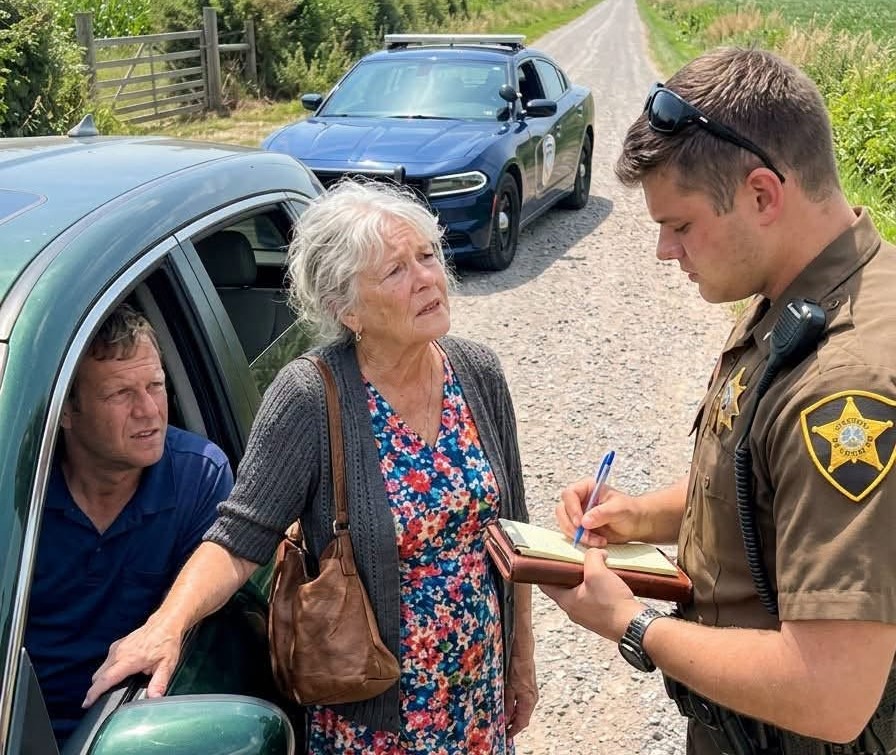
The same man who had stopped us on County Road 6.
I stared at the page.
“Mom, why is his name here?”
Frank exhaled.
“Because this is where things become complicated.”
My mother looked at him.
“Explain.”
Frank pointed to a paragraph.
It documented a training session Collins had attended early in his career.
The session concerned temporary identification documents.
And according to the attendance record, the instructor had been my mother.
I looked at her.
“You trained him?”
She studied the document.
“I trained dozens of new employees and officers over the years.”
Frank nodded.
“But there’s more.”
He removed another sheet.
It was a handwritten acknowledgment signed by Collins.
The date was January 22, 2015.
The statement confirmed that he had received training on document verification, dispatch procedures, and respectful communication during roadside interactions.
My mother read it carefully.
Then she leaned back.
“Then he knew.”
Frank nodded.
“He had received the information.”
I felt anger rising.
“So he knew exactly what he was supposed to do when he stopped her?”
Frank raised a hand.
“We shouldn’t jump to conclusions. Training records don’t prove what someone remembers years later.”
My mother nodded.
“That’s true.”
She placed the paper down.
“But it does establish that the procedure was available to him.”
Frank agreed.
Then he reached into the box and pulled out a final document.
“This is the part I wanted you to see.”
It was an internal email.
The sender’s name had been partially blacked out in the copy.
The subject line read:
TEMPORARY CREDENTIAL VERIFICATION — TRAINING CONCERNS.
My mother began reading.
The message referred to several complaints involving officers who had failed to verify documents before issuing citations.
It recommended refresher training.
But the response below it was what caught my attention.
Someone had written:
“Additional training is unnecessary. Officers should be able to recognize legitimate documents without relying on dispatch for every questionable encounter.”
My mother slowly removed her glasses.
“That is not how the procedure works.”
Frank nodded.
“I know.”
She looked at him.
“Who wrote that?”
Frank hesitated.
Then he gave us a name.
Richard Harlan.
My mother went completely still.
“Richard?”
Frank nodded.
“He was the deputy chief at the time.”
She looked down at the document.
“Richard knew better.”
“Apparently.”
My mother closed the folder.
“Did he ever respond to the complaints?”
Frank shook his head.
“That’s what we haven’t established.”
I watched my mother’s face.
She wasn’t angry in the way I expected.
She looked disappointed.
Almost heartbroken.
“Richard attended those meetings,” she said quietly. “He knew why we created the procedure.”
Frank lowered his voice.
“Eleanor, there’s another issue.”
My mother looked up.
“What now?”
“The county administrator has asked us to determine whether the missing records were intentionally removed from the archive.”
My heart began beating faster.
“Why would someone remove them?”
Frank looked at me.
“That’s what we don’t know.”
My mother slowly stood.
She walked to the kitchen window.
Outside, a squirrel was attempting to climb the bird feeder.
She watched it for a moment.
Then she turned around.
“Frank, I want copies of everything you’re allowed to share with me.”
He nodded.
“And I want the names of the people who filed those complaints.”
He hesitated.
“Some of those records contain private information.”
“Then protect their identities. I don’t need their personal details. I need to know whether their concerns were properly addressed.”
Frank smiled faintly.
“That’s exactly why I came here.”
He packed the folders back into the box.
Before leaving, he stopped near the front door.
“Eleanor?”
“Yes?”
“I should tell you something.”
She waited.
“When you retired, several of us believed the new system was functioning properly. We thought the procedures you helped create would continue protecting people.”
He looked down.
“But somewhere along the way, things changed.”
My mother nodded.
“Then we need to find out when.”
Frank left.
I stood beside the window, watching his car disappear down the street.
Then I turned toward my mother.
“Mom, are you worried?”
She looked at the empty kitchen table.
“Yes.”
I wasn’t expecting that answer.
“About what?”
She folded her hands.
“Not about myself.”
She paused.
“I’m worried about the people whose complaints were never heard.”
That afternoon, I helped her organize the copies Frank had brought.
We sorted them by year.
We created separate folders for training records, complaints, dispatch procedures, and administrative decisions.
It took hours.
At around five o’clock, I noticed something unusual.
Three documents had the same reference number.
But they were dated months apart.
I placed them side by side.
“Mom, look at this.”
She walked over.
“What is it?”
“These three documents. They all have the same reference number.”
She examined them.
The first was a complaint.
The second was an internal review.
The third was a closure notice.
My mother looked at the dates.
Then she frowned.
“That’s impossible.”
“Why?”
She pointed to the closure notice.
“This document says the complaint was reviewed and resolved before the review was even opened.”
I stared at the dates.
She was right.
The closure notice was dated four days before the internal review.
I turned the page.
There was another strange detail.
The signature belonged to someone who had retired two years earlier.
My mother slowly sat down.
“Jeffrey, I think we need to speak to Frank again.”
I picked up my phone.
But before I could call him, it rang.
It was Frank.
I answered.
“Frank?”
His voice was tense.
“Jeffrey, is your mother there?”
“Yes.”
“Put me on speaker.”
I did.
My mother came closer.
“Frank?”
“Eleanor, I found something.”
“What?”
“I located the original archive transfer log.”
She leaned forward.
“And?”
There was a long pause.
Then Frank said:
“The records weren’t accidentally lost.”
My mother gripped the edge of the table.
“What are you saying?”
“Someone authorized their removal from the active archive.”
“Who?”
Frank lowered his voice.
“I haven’t confirmed the identity yet. But the authorization was entered under the office of the deputy chief.”
My mother looked at the document bearing Richard Harlan’s name.
Then Frank added something that made the room go completely silent.
“Eleanor, the authorization was submitted just eleven days after you sent your final retirement memorandum.”
I looked at my mother.
She didn’t blink.
Then she asked:
“What did my retirement memorandum say?”
Frank answered.
“You recommended an independent audit of the temporary credential verification process.”
My mother slowly closed her eyes.
I felt a chill run down my back.
Because suddenly, the missing records no longer looked like an ordinary administrative mistake.
They looked connected to something my mother had tried to prevent before she retired.
And there was one question nobody could answer.
Why would someone remove the records just eleven days after Eleanor Whitaker asked the county to investigate the very system those records were supposed to protect?
My mother reached for her glasses.
“Frank,” she said quietly, “I want you to find the original memorandum.”
“I’ll do everything I can.”
“And Richard Harlan?”
Another pause.
“He’s still alive, Eleanor.”
My mother looked at me.
Then she said:
“Then perhaps it’s time we asked him what happened.”
But what we didn’t know was that Richard Harlan had already heard about the investigation.
And according to Frank, he had made one telephone call that afternoon.
A call to someone who had been present at the courthouse on the day my mother retired.
Someone whose name appeared nowhere in the official records.
Someone who might know exactly why those files had disappeared.
And the next morning, that person would arrive at my mother’s front door.
TO BE CONTINUED…
CLICK HERE TO CONTINUOUS READ FULL ENDING STORY PART👉 (5): – A deputy stopped my seventy-one-year-old mother

One Comment on “PART 4: – A deputy stopped my seventy-one-year-old mother”